
All garage doors are lifted by springs that counterbalance the weight of the door. Even the lightest doors weigh nearly 100 lbs., and many residential doors are in the 400-500 lb. range. There are several different types of spring systems but the vast majority of garage doors in the Gresham, Happy Valley, Clackamas and Damascus area use either a Standard Torsion System or the TorqueMaster system (only found on some models from the Wayne Dalton brand). If you use your garage door regularly, a broken spring is inevitable, usually after about 10,000 lifts. It is the most common reason for a garage door failing to open.
Why Did My Garage Door Spring Break?
There is only one thing that causes garage door springs to break – use. On most residential doors, the torsion spring makes seven or eight revolutions every time it lifts and closes, eventually leading to failure from metal fatigue.
If a repair technician tells you that you should purchase upgraded rollers or other parts because they will make your new springs last longer, he’s wrong.
While worn out rollers or bearings can cause other problems (lots of noise, rough operation, jamming, and stripped opener gears for example), they will not cause your spring to fail – the spring supplies a steady amount of force, it does not work harder or less hard based on any other factors.
Many companies deliberately train their employees to believe the falsehood that worn rollers and bearings make the springs work harder – it’s much easier for a repair technician to upsell with a straight face and clean conscience if he believes he is giving good advice. And most people (both employees in training and customers) accept the simple explanation that low quality or worn rollers and bearings make the spring work harder. But it’s not true.
*Please don’t take this to mean that those other parts never need to be replaced. Worn rollers, bearings, cables, drums, and brackets absolutely should be replaced. But if your technician is telling you that you have low quality parts on your door, and the spring will last longer if you upgrade, you are on the receiving end of an upsell. Any parts that are truly in need of replacement will be showing signs of wear that you can see, or will be affecting how the door works in a way that can be demonstrated to you.
When Will My Garage Door Spring Break?
The lifespan of a spring is rated in cycles. A cycle is one time up and back down again. The cycle life is partly determined by the type of metal used, but is mostly the result of a combination of the spring’s wire size, length, and inside diameter. As a rule of thumb, the longer and bigger the diameter, the longer it will last.
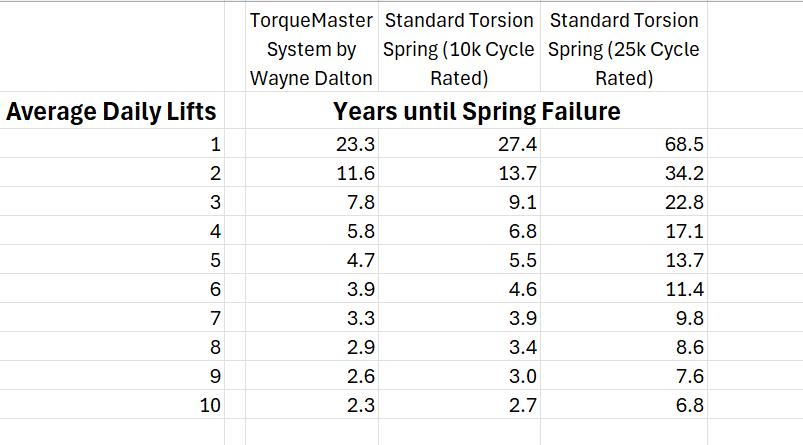
Some new doors come with a standard torsion spring system that is rated for 10,000 cycles. Others use the TorqueMaster system which the manufacturer claims is rated for 10,000, but based on real world experience I believe it is a bit less than that.
I always recommend using “high cycle” springs if possible. In fact, all the springs we carry for replacement are intended for a minimum of 25,000 lifts.
Here is a chart that should give you an idea of when to expect a broken garage door spring.
How to Tell if Your Garage Door has a Broken Spring
These are some common signs that you are dealing with a broken spring
- Door either doesn’t lift at all, or lifts just a few inches and stops
- Garage door lifting slower than usual, motor struggling, or opener rail flexing downward during operation
- Garage door lands much harder than it used to when closing
- Loud, unexplained crashing sound coming from the garage
- Loose cables
- Visible broken spot in spring
When the spring breaks, your garage door becomes dead weight and won’t lift. The garage door opener SHOULD, if it was installed properly, start to pick it up, feel the unexpected weight, and automatically shut off. Sometimes it will remain on the ground, while other times it will lift a few inches and stop. If you pull the release cord to disconnect the door from the opener, you will find that it feels very heavy when operated by hand. Be very careful about pulling the release if your door is stuck above the ground — if the spring is broken it will come down hard. Watch your toes and make sure there are no kids or pets around!
Many garage door openers are not adjusted properly and will continue to lift the door despite the spring being broken. This is very hard on the motor and the door. If your door suddenly starts to lift slower than usual, lands hard, or the motor seems to be struggling, you should check for a broken spring. Do not continue to operate the door until you figure out what the problem is or you risk doing expensive damage.
WARNING: If you suspect a broken spring, only pull the manual release with the door either on the ground or at most 6” above it. If the spring is in fact broken your door will slam shut. This is dangerous and it can damage the door.
When garage door springs snap, they make a crazy noise. The most common way my customers describe it is they thought something fell over in the garage, or that someone drove into their door from the outside. If you are at home there is a good chance you will hear it. While it’s most common for a spring to break shortly after the garage door has been shut, they can go off pretty much any time the door is in the closed position.
Sometimes a broken spring will lead to a lift cable that has come loose and ends up dangling from the door. This typically happens on doors that are light enough that they are lifted by a single spring – when it breaks there is no more tension keeping the cable ends seated in the drum.
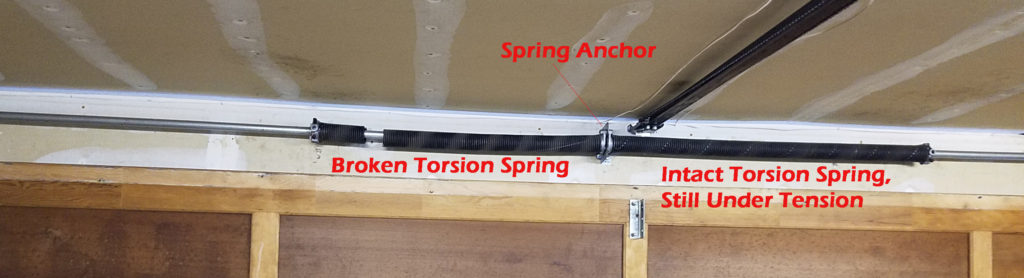
On standard torsion spring systems, the broken spring will be easy to see.
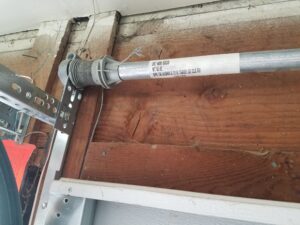
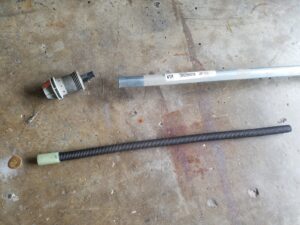
However, many newer homes have a garage door that came with the Wayne Dalton TorqueMaster spring system, which has skinny little springs that are hidden inside of a silver tube. You cannot tell if they are broken by looking at them. This is an inferior spring system that should be converted to a standard torsion system when it fails.
Should I Have Both Springs Replaced when One Breaks?
If your door is heavy enough that it uses two springs, you will be doing yourself a favor to have both replaced at the same time. Assuming they were both installed at the same time, the second spring is bound to break sometime soon, usually within at most a few hundred cycles. I have had customers who insisted on only replacing the one that was broken and ended up having to call me back less than a week later when the second spring failed.
Factors that Reduce Garage Door Spring Life
There are a couple things that can reduce the lifespan of a garage door spring:
- Low cycle rating
- Over winding a spring that is too weak for the door
- Temperature fluctuations
Many companies carry springs that are only rated for 10,000 lifts. They work fine on a day-to-day basis, but they don’t last very long. We carry “high cycle” springs that are rated for 20,000 to 30,000 lifts which is a nice compromise between longevity and price. If you do the math, you will pay far less on a per-lift basis for high cycle springs than you will for standard 10k cycle springs.
It is critical that your spring(s) be replaced with one that is the correct strength for the weight of your door. One of the most common ways a lazy or incompetent technician botches a repair job is by using the wrong spring. There are many garage door models that look nearly identical (Wayne Dalton 9100 and 9600, or Taylor T-Core and Encore) but are significantly different weights, so it is easy to get confused. If the spring turns out to be too weak, many technicians add extra tension instead of redoing the whole job. This dramatically reduces the cycle life.
Temperature fluctuation can also have an impact on spring life. Luckily, here in Western Oregon we have a relatively stable temperature range most days of the year. But, when it gets really cold or hot, we do see an increase in the number of calls for broken spring replacement. The simplest way to explain it is that extreme cold and heat don’t CAUSE springs to break, but it does make a lot of springs that were going to break soon fail at the same time.
Proper Spring Strength is Critical
Your door and opener will not work properly, and both could be damaged, if the wrong strength springs are used.
If too strong, your door will want to lift off the ground on its own. I have seen over-sprung doors that fly open so hard that I could barely get them closed using all my strength and weight.
*It is not possible to compensate for this by reducing the number of turns on the spring, as this will result in the springs being fully unwound before the door reaches the open position—the lift cables will fall off the drums and the door will become jammed.
Using too weak of a spring creates the opposite problem. The door will still be heavy off the ground, and adding turns to the spring to make the door feel lighter will give it a “hot” action near the top. This will make it hard for the opener to start closing the door and will drastically reduce the lifespan of the springs. If your door has been going through springs quickly even though it doesn’t get excessive use, you probably had the wrong springs installed at some point.
This happens because the easiest way to calculate spring strength is to simply match the old one. So, if the wrong springs were installed in the past, the next time they break your repair technician is likely to match the same (wrong) springs resulting in a vicious cycle of premature spring failures. A good technician will redo the job with the proper springs if this happens.
Contact Us
Fill out this easy contact form to get a quote, schedule a service call, if you need help troubleshooting, etc. If looking to schedule an appointment, please include your zip code or general area.
"*" indicates required fields
